Acoustics: A Key Consideration for Metal Building Insulation
By the National Insulation Association (NIA) Metal Building Laminator Committee
The impact of acoustics on human productivity in commercial and industrial buildings is profound. Studies such as one published in Electronic Physician1 have shown that there is a direct and significant association between
levels of sound present in an environment and the quality and length of human output. Additionally, both the U.S. Environmental Protection Agency and OSHA have published requirements and standards, respectively, for maximum noise levels in interior
spaces, recognizing sound as a significant environmental factor that affects our health. Cue metal building insulation (MBI), which plays a critical role in not only the thermal efficiency of a structure, but the acoustical performance, too.
Due to its porous nature, MBI is an excellent absorber of sound. According to the North American Insulation Manufacturers Association (NAIMA), MBI can reduce noise levels in a building by up to 5 to 6 decibels (dB)2. In addition to decreasing
outside noise transmission to the interior environment, MBI also reduces noise created inside a building. Sound abatement properties may seem like an added benefit, but MBI becomes a crucial building material for applications in which sound potentially
reaches dangerous noise levels, such as compressor stations and other buildings with loud, heavy machinery.
When it comes to assessing acoustical performance, sound transmission class, also known as STC, ratings are important. Intended to demonstrate the amount of sound that can pass through an assembly, STC ratings have been utilized for many years and are
based on speech sounds. The higher the STC value, the better a construction reduces the transmission of sound. The average metal building ranges from a low of about 20 to a high of 55.3
In addition to STC ratings, there are three important fundamentals to sound transmission:
- Decibels (dB), which is a measurement of how loud a noise is.
- Sound transmission loss (STL), which is the ability of a wall or roof to reduce the amount of sound transmitted. STL is calculated by the dB difference from one side of a wall or roof to another.
- Frequency, which is quantified in Hertz (Hz) and is the measurement of a tone. When conceptualizing frequency, it is helpful to think of a musical instrument. High-tone instruments have a 2,000 Hz range, and low-tone instruments have a 29 Hz range.
Another important sound transmission assessment is the concept of noise reduction coefficients, or NRC, ratings—a measurement of how well a material absorbs sound. NRC ratings are measured on a scale of 0 to 1, with 0 representing no sound absorption,
and 1 meaning the material absorbs 100% of the sound. A .85 rating equals 85% sound absorption, etc.
Building codes should also be part of the acoustics conversation, as newer energy codes require more insulation in metal buildings than ever before. Gone are the days of installing 6” R-19 roof insulation and 4” R-13 wall insulation on all
projects. Today, high R-value insulation systems have become standard in many climate zones, which means that thicker rolls of fiberglass—and more of it—are installed in roofs and walls. Fiberglass is the most common MBI material choice
for a variety of reasons, including ease of installation, low installed cost per R-value, excellent thermal performance, and—you guessed it—superior acoustical properties. The greater thicknesses of fiberglass required by today’s
energy codes lead to better overall acoustical performance (see Figure 1 and Figure 2 ).
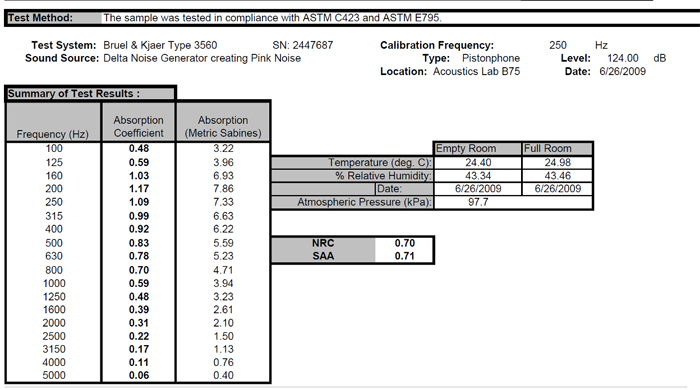
Figure 1. Liner systems, which are high R-value fiberglass systems, include a vapor barrier, foam tape, and fiberglass. A test liner system installed in a metal building roof gleaned an NRC of 0.70.
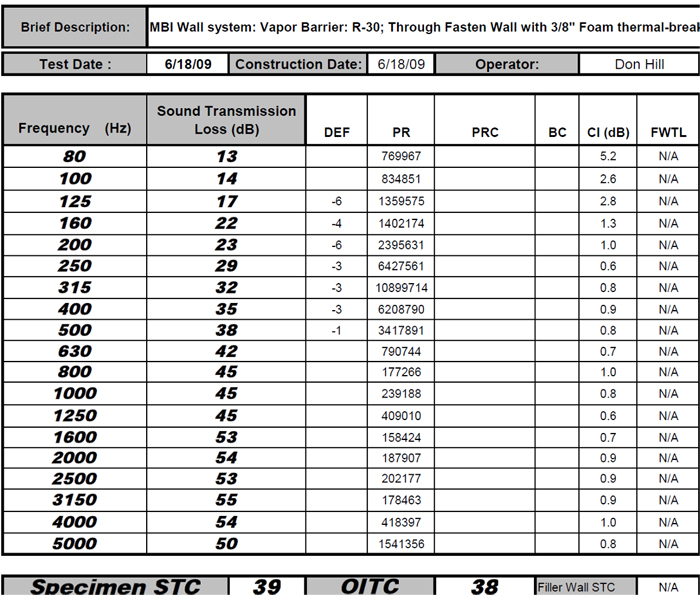
Figure 2. A test sample of a liner system installed in a metal building wall gleaned an STC rating of 39.
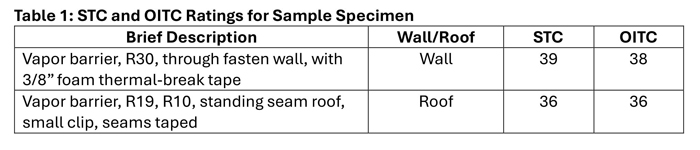
Per Owens Corning, Table 1 presents a summary of the specimen STC and outdoor-indoor transmission class (OITC) ratings for STL testing per ASTM E-90-09.

Table 2 presents a summary of specimen NRC and sound absorption average (SAA) ratings for sound absorption testing per ASTM C423-09a and E795-05, as measured under Work Order 90352.
Conclusion
Pre-engineered metal buildings are known for their durability, versatility, and economic value, and they represent a significant portion of new commercial and industrial construction in the United States. However, as with any construction type, metal
buildings pose their own unique set of challenges. At the top of that list is noise transmission, which can be addressed with the right amount of NAIMA 202® certified fiberglass.
References
- Khajenasiri F, Zamanian A, Zamanian Z. The Effect of Exposure to High Noise Levels on the Performance and Rate of Error in Manual Activities. Electron Physician. 2016 Mar 25;8(3):2088-93. doi: 10.19082/2088. PMID: 27123216; PMCID: PMC4844473.
- “Insulation Facts #58: The Facts About the Acoustical Performance of Metal Building Insulation,” NAIMA, Pub. No. MB315 4/01.
- Ibid
This article was written by a task force from the National Insulation Association’s (NIA’s) Metal Building Laminator Committee. The member companies that make up this committee are:
• Bay Insulation Systems, Inc. (www.bayinsulation.com)
• DAW Construction Group, LLC (www.dawcg.com)
• The E.J. Davis Company (www.ejdavis.com)
• International Insulation Products, LLC (www.iiproducts.com)
• L&L Insulations (www.llinsulation.com)
• Silvercote, A Service Partners Company (www.silvercote.com)
• Therm-All, Inc. (www.therm-all.com)
You can learn more about metal building insulation at www.insulatemetalbuildings.org. Read the newly revised NIA Certified Faced Insulation® Standard (Version 404.2–2024) at
www.insulation.org/mblstandard. To learn more about NIA’s Metal Building Laminator Committee, or to join, email membership@insulation.org. For questions or comments about any of the articles, please email
publications@insulation.org.
About The National Insulation Association
 NIA is a not-for-profit trade association representing both the merit (open shop) and union contractors, distributors, laminators, fabricators, and manufacturers that provide thermal insulation, insulation accessories, and components to the commercial, mechanical, and industrial markets throughout the U.S. Since 1953, the northern Virginia–based association has been the voice of the insulation industry and is dedicated to keeping the commercial and industrial insulation industry up to date on the latest industry trends and technologies. For more information, visit www.insulation.org.