AIA's December Billings Survey Shows Fewer Firms Reporting Declines
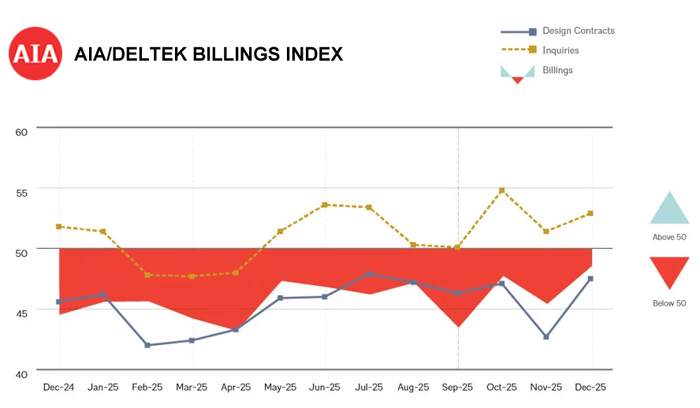
Washington, DC – The American Institute of Architects' AIA/Deltek Architecture Billings Index® (ABI) closed out 2025 in negative territory with a December score of
48.5, up from 45.3 in November. Any score below 50 indicates a billings decline, although this month’s score indicates that fewer firms reported a decline in billings in December than in November.
Architecture firm billings declined throughout 2025 and most months since October 2022, with only three exceptions. While fewer firms reported a decrease in December, declining design contract values suggest a near-term rebound is unlikely. However, firm
backlogs remain strong, averaging 6.3 months. Large firms with annual billings of $5 million or more report backlogs of 8.6 months, while institutional specialists average 8.2 months. Despite a decline in project inquiries and the value of newly signed
design contracts, work pipelines have remained stable in recent years.
“Despite the ongoing decline in billings at most architecture firms, there are a few signs of potential improvement on the horizon. The number of inquiries into future project work continues to grow, and Midwest firms saw billings increase for the
fourth consecutive month in December,” said AIA Chief Economist, Kermit Baker, Hon. AIA, PhD. “In general, however, overall conditions remain weak across all specializations. Multifamily residential firms faced the steepest declines, while
institutional firms experienced a slightly slower pace of decline compared to earlier in the year.”
Key ABI highlights for December include:
• Regional averages: Midwest (51.7); South (47.7); West (45.3); Northeast (44.2)
• Sector index breakdown: institutional (48.7); commercial/industrial (47.8); multifamily residential (45.5); mixed practice (firms
that do not have at least half of their billings in any one other category) (44.0)
• Project inquiries index: 52.9
• Design contracts index: 47.5
The
regional and sector categories are calculated as three-month moving
averages and may not always average out to the national score.
About The American Institute Of Architects
 For over 150 years, members of the American Institute of Architects have worked with each other and their communities to create more valuable, healthy, secure, and sustainable buildings and cityscapes. Members adhere to a code of ethics and professional conduct to ensure the highest standards in professional practice. Embracing their responsibility to serve society, AIA members engage civic and government leaders and the public in helping find needed solutions to pressing issues facing our communities, institutions, nation and world. For more information, visit www.aia.org.